
With the rapid growth of off-grid solar systems, RV energy storage, backup power solutions, and portable energy applications, 48V 50Ah LiFePO4 batteries have become increasingly popular.
Many users ask an important question when selecting an inverter:
Can a 48V 50Ah LiFePO4 battery reliably power a 3000W inverter?
The answer is not simply “yes” or “no.” The actual performance depends on multiple factors, including:
- Battery voltage
- Battery capacity
- Maximum discharge current
- BMS limitations
- Inverter efficiency
- Required operating time
- Load characteristics
Only with proper matching can the system operate safely and efficiently.
1. Understanding the Basic Specifications of a 48V 50Ah LiFePO4 Battery
First, we need to understand the basic energy parameters.
The theoretical energy capacity of a 48V 50Ah battery is:
48V × 50Ah = 2400Wh
This means:
A 48V 50Ah LiFePO4 battery stores approximately 2.4kWh of energy.
In real applications, due to:
- Inverter efficiency losses
- BMS protection limits
- Battery depth-of-discharge restrictions
the usable energy is usually around:
2.0kWh.
2. How Much Current Does a 3000W Inverter Require?
The most important factor in determining compatibility is the required input current.
The calculation formula is:
Current (A) = Power (W) ÷ Voltage (V)
Therefore:
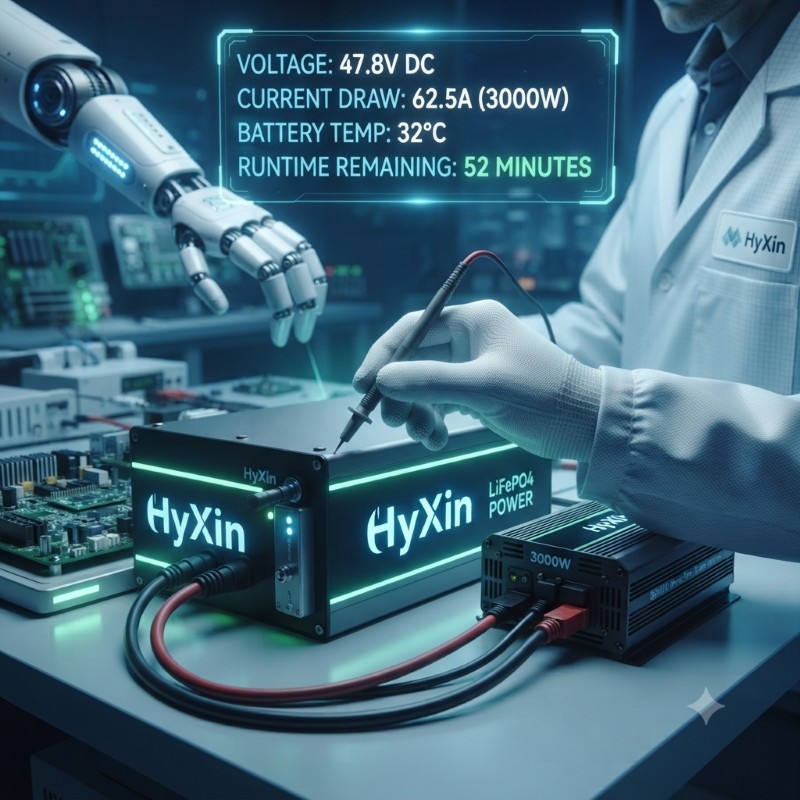
3000W ÷ 48V ≈ 62.5A
This means:
A 3000W inverter operating at full load requires approximately:
62.5A continuous input current.
Considering inverter efficiency:
Assuming 90% efficiency:
3000W ÷ 48V ÷ 0.9 ≈ 69A
Therefore, the actual requirement is approximately:
65–70A continuous current.
3. Can a 48V 50Ah LiFePO4 Battery Meet the Current Requirement?
The answer depends on the battery design.
Different 48V 50Ah batteries have different BMS ratings and discharge capabilities.
| Battery Configuration | Maximum Continuous Discharge | Can It Support a 3000W Inverter? |
|---|---|---|
| 50A BMS | 50A | Not recommended |
| 60A BMS | 60A | Close to the limit |
| 80A BMS | 80A | Suitable |
| 100A BMS | 100A | Recommended |
Therefore:
Battery capacity (50Ah) is not the only determining factor. Maximum discharge current is the key factor.
4. Key Factors Affecting a 48V 50Ah Battery Powering a 3000W Inverter
1. BMS Discharge Capability
The Battery Management System (BMS) controls:
- Over-current protection
- Over-charge protection
- Temperature protection
- Cell balancing
If the BMS limits output to 50A, even a stronger battery cell cannot deliver enough power.
For a 3000W inverter system, the recommended requirement is:
BMS continuous discharge current ≥70A
An ideal configuration would be:
80A–100A BMS.
2. Cell Discharge Rate
LiFePO4 cells are available with different discharge capabilities.
For example:
1C discharge:
50Ah × 1C = 50A
2C discharge:
50Ah × 2C = 100A
High-rate cells can provide greater instant power output.
3. Inverter Startup Surge Power
Many devices require significantly higher power during startup.
Examples include:
- Refrigerators
- Water pumps
- Motors
- Air conditioners
Startup power can reach:
2–3 times the rated power.
A 3000W inverter may require:
6000W or higher peak output.
Therefore, the battery must support high surge current.
5. How Long Can a 48V 50Ah Battery Run a 3000W Inverter?
Battery energy:2400Wh
Inverter efficiency:90%
Usable energy: 2400Wh × 0.9 ≈ 2160Wh
At a 3000W load:
Operating time: 2160Wh ÷ 3000W ≈ 0.72 hours
Approximately: 40–45 minutes.
Therefore:
A 48V 50Ah LiFePO4 battery can power a 3000W inverter, but it cannot provide long-term operation at full power.
6. Estimated Runtime Under Different Loads
| Load Power | Estimated Runtime |
|---|---|
| 300W device | Around 7 hours |
| 500W device | Around 4 hours |
| 1000W device | Around 2 hours |
| 2000W device | Around 1 hour |
| 3000W device | Around 40 minutes |
Actual runtime depends on:
- Temperature
- Battery aging
- System efficiency
7. Suitable Applications for a 48V 50Ah LiFePO4 Battery with a 3000W Inverter
Suitable Applications:
Off-Grid Solar Systems
Examples:
- Small residential energy storage
- Outdoor power systems
- Solar backup systems
RV Applications
Supporting:
- Small appliances
- Lighting
- Electronic devices
Industrial Backup Power
Examples:
- Communication equipment
- Control systems
- Automation devices
Less Suitable Applications:
Long-term operation of:
- Air conditioners
- High-power heaters
- Electric ovens
because the battery capacity is limited.
8. How to Select the Right 48V LiFePO4 Battery for a 3000W Inverter
Recommended configuration:
| Parameter | Recommendation |
|---|---|
| Voltage | 48V |
| Capacity | 50Ah or higher |
| BMS Rating | ≥80A |
| Battery Cell | High-rate LiFePO4 |
| Cycle Life | 3000–6000 cycles |
| Protection Level | IP65 or higher |
For longer operating time:
A: 48V 100Ah LiFePO4 battery is recommended.
Energy capacity: 48V × 100Ah = 4800Wh
Providing approximately twice the runtime.
9. HyXin’s Value in 48V LiFePO4 Battery Solutions
As a professional new energy battery solution provider, HYXin focuses on high-performance LiFePO4 battery packs, customized lithium battery systems, and intelligent BMS management solutions.
For applications including:
- 48V energy storage systems
- Solar inverter systems
- Electric vehicles
- Off-grid power solutions
HYXin provides:
- High-rate LiFePO4 cell selection
- High-current BMS design
- Customized battery structures
- Long-cycle-life battery systems
By accurately matching battery capacity, discharge capability, and application requirements, HYXin helps customers build safer, more efficient, and more reliable energy systems.
Conclusion
So, can a 48V 50Ah LiFePO4 battery power a 3000W inverter?
The answer is:
Yes, but only under the right conditions:
- The BMS continuous discharge capability should be above 70A
- The battery cells must support sufficient discharge rates
- The inverter should operate efficiently
- The load should not exceed the battery’s long-term capability
For short-term 3000W output, a high-quality 48V 50Ah LiFePO4 battery can meet the requirement.
However, for continuous operation of 3000W equipment, a larger battery system is recommended:
48V 100Ah or higher LiFePO4 battery.
With the rapid development of energy storage, solar power, and smart devices, high-safety, high-efficiency, and intelligent LiFePO4 battery systems will become an essential energy foundation for residential, commercial, and off-grid applications.

About HyXin
HyXin is a professional battery solution provider specializing in customized lithium battery packs, LiFePO4 battery systems, intelligent BMS solutions, and advanced energy storage technologies.
With expertise in battery design, high-current discharge solutions, and application-specific customization, HyXin provides reliable energy solutions for solar storage systems, electric vehicles, commercial equipment, and industrial applications.
Through continuous innovation and engineering development, HyXin is committed to delivering safer, smarter, and more efficient battery solutions for the global new energy market.
Please contact us for more information.