
In the world of solar energy, the controller acts as the “brain” of your system. Choosing between a PWM and an MPPT controller, and matching it correctly with your battery bank, can be the difference between a high-performing system and one that prematurely fails.
Here is everything you need to know to make the right choice.
1. PWM vs. MPPT: What’s the Real Difference?
To choose correctly, you must first understand how these two technologies handle energy.
PWM (Pulse Width Modulation)
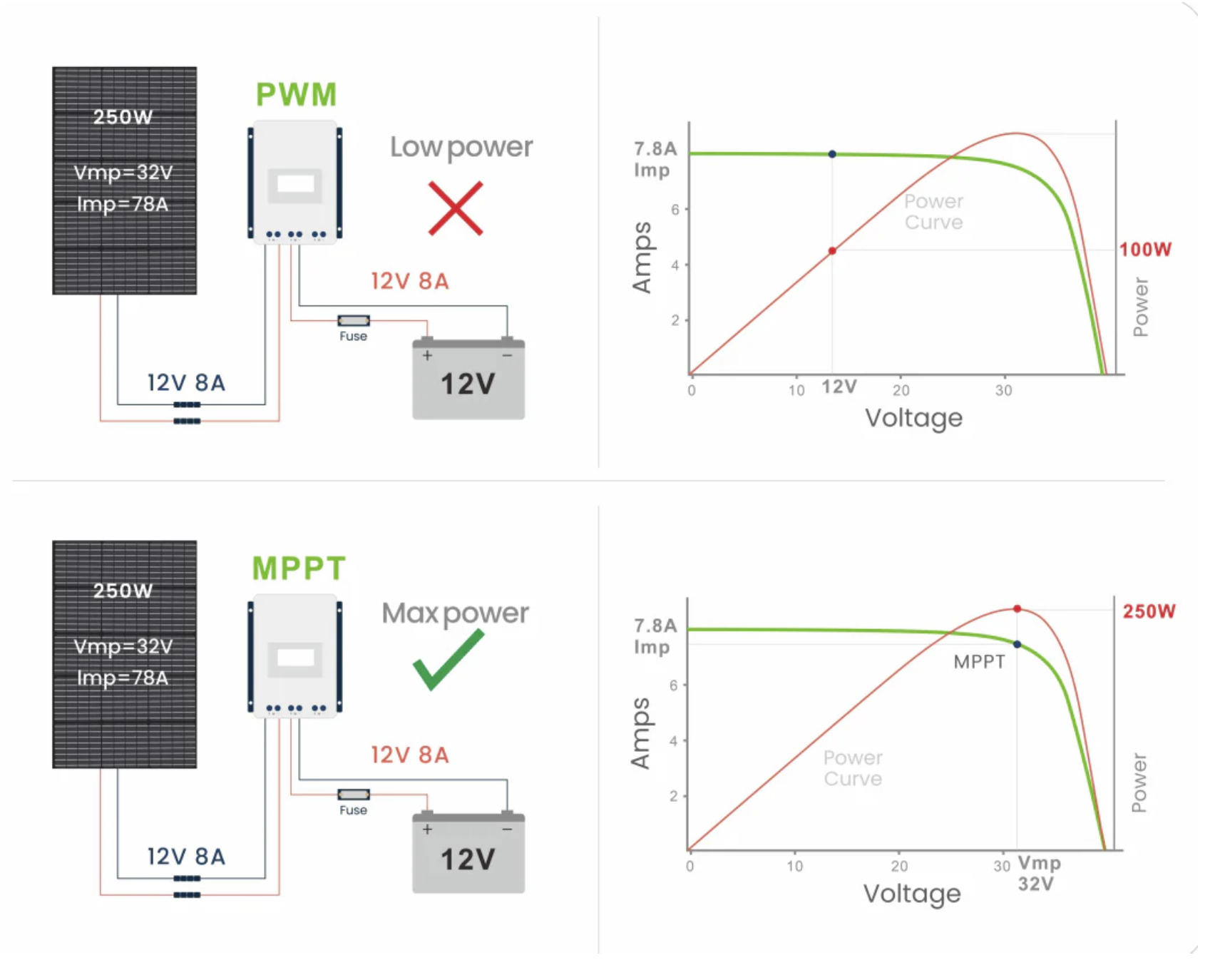
Think of PWM as a “Standard Switch.” It acts as a direct connection between your solar panels and the battery.
-
How it works: When the battery is nearly full, it rapidly “flicks” the switch on and off to maintain the voltage.
-
The Downside: It cannot adjust voltage to increase current. If your panel is 18V and your battery is 12V, the extra 6V is simply wasted.
-
Best for: Small, simple systems (e.g., maintaining a single battery in a shed) where budget is the priority.
MPPT (Maximum Power Point Tracking)
Think of MPPT as a “Smart Transformer.” It is significantly more advanced and efficient.
-
How it works: It constantly monitors the panel’s output and calculates the “Maximum Power Point.” It takes the excess voltage from the panels and converts it into extra current for the battery.
-
The Advantage: It is 25%–30% more efficient than PWM, especially in cold or cloudy weather.
-
Best for: Professional setups, RVs, off-grid homes, and any system using large solar arrays.

2. The Golden Rule: How to Size Your MPPT
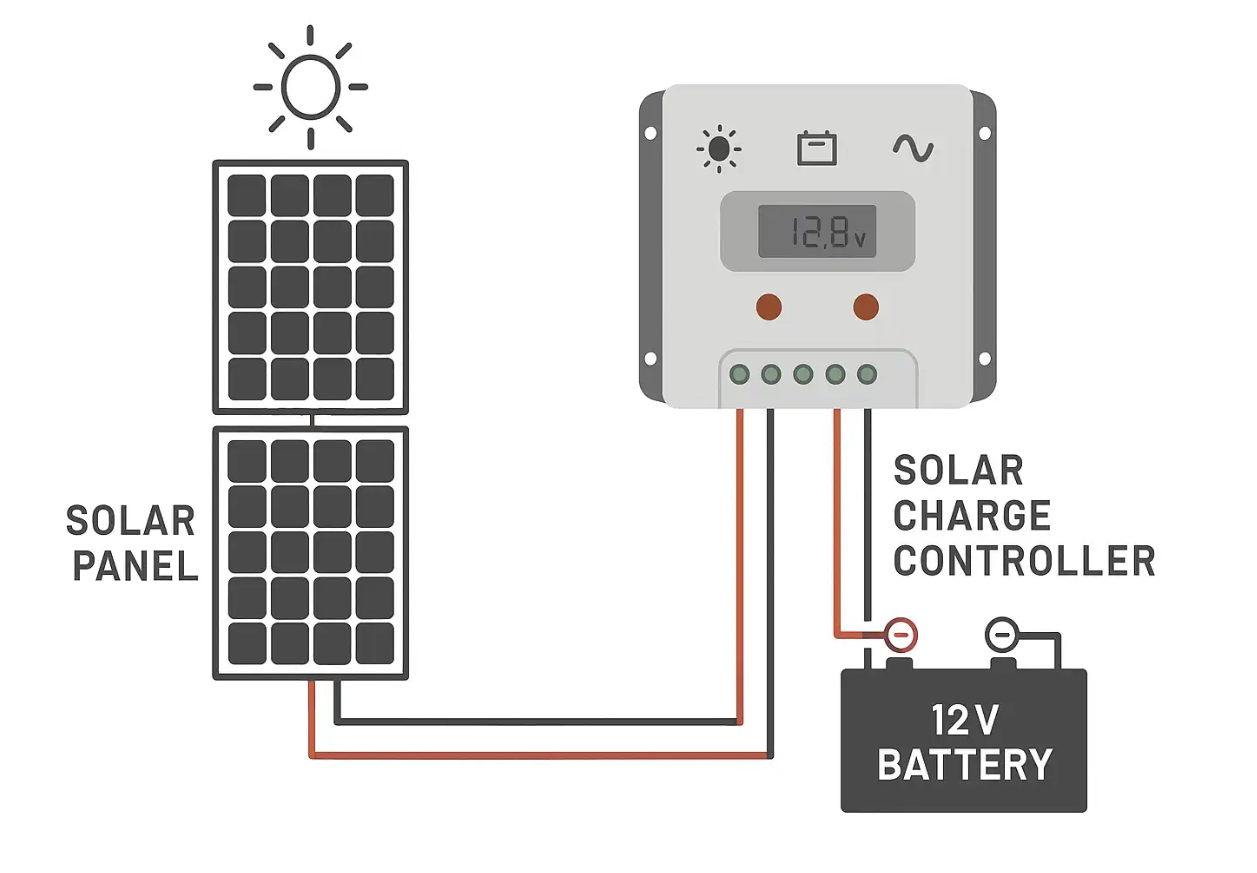
When selecting an MPPT, you must look at two directions: Up (to your solar panels) and Down (to your battery).
A. Look Up: Solar Panel Voltage (Voc)
The most common way to destroy an MPPT is by exceeding its Maximum Input Voltage.
-
Check the Voc (Open Circuit Voltage) on the back of your solar panels.
-
If you connect panels in Series, their voltages add up.
-
Rule: Your total array voltage must be at least 15% lower than the MPPT’s rated limit to account for cold weather (which causes voltage to spike).
B. Look Down: Charging Current (Amps)
The MPPT’s rating (e.g., 40A, 60A) refers to how much current it can send to the battery.
-
Formula: $Total Solar Watts \div Battery Voltage = Required Amps$.
-
Example: If you have 800W of panels and a 12V battery: $800W \div 12V = 66.6A$. You would need a 80A MPPT.

3. The Critical Factor: Battery Matching
A controller is only as good as its compatibility with your batteries.
Capacity Matching (Ah)
Don’t pair a tiny MPPT with a massive battery bank, or vice versa.
-
Large Batteries (e.g., 600Ah+): Require high-current MPPTs (60A–100A). If the current is too low, the battery may never reach a full charge during the limited hours of sunlight.
Chemistry Consistency (The “BMS” Rule)
Modern systems often use LiFePO4 (Lithium) batteries.
-
Warning: Ensure your MPPT has a dedicated “Lithium” mode. Lithium batteries have specific charging profiles. Using a standard “Lead-Acid” setting can damage the Battery Management System (BMS) or the cells.
Avoid “Mixing” Batteries
One of the most common mistakes is connecting batteries of different capacities (e.g., a 200Ah and a 600Ah) to the same MPPT.
-
The Risk: Different capacities mean different internal resistances. During heavy use, the smaller battery will be overworked, causing the BMS to trip or the battery to overheat.
-
Solution: Always use batteries of the same brand, age, and capacity in a single bank.
Summary Checklist for Buyers
Before you purchase, confirm these four points:
-
Efficiency: Does the total solar wattage divided by battery voltage fit the MPPT’s Amp rating?
-
Safety: Does the solar array’s total Voc stay safely below the MPPT’s max input voltage?
-
Battery Type: Does the controller support your specific battery chemistry (Lead-acid, Gel, or Lithium)?
-
Future Proofing: If you plan to add more panels later, buy an MPPT with a higher Amp rating now to save money in the long run.
Choosing a high-quality MPPT is an investment. While it costs more upfront than a PWM, the increased efficiency and battery protection will pay for itself within the first year of use.