
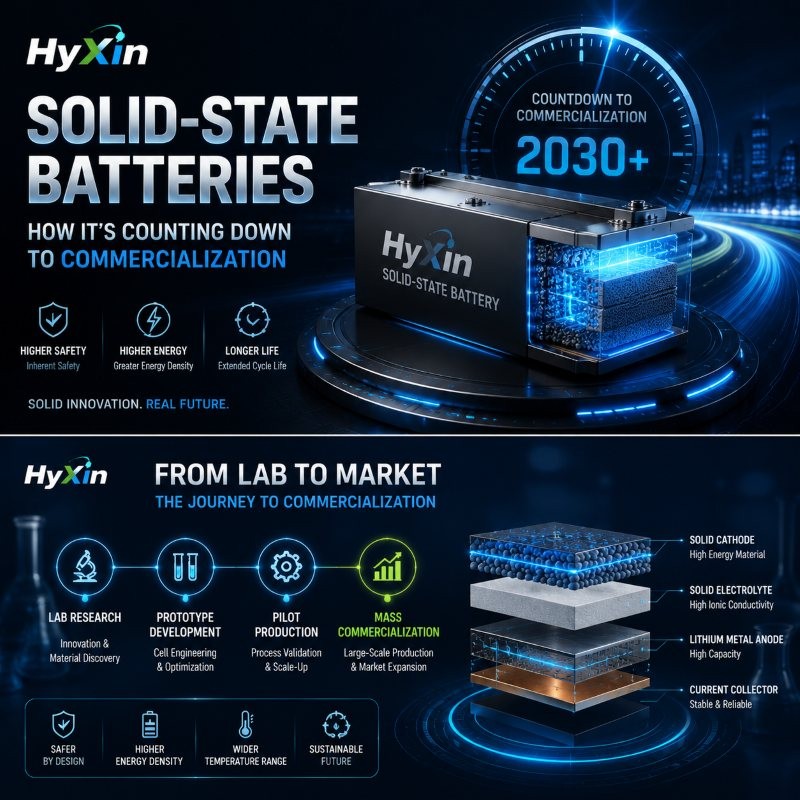
वैश्विक नवीन ऊर्जा उद्योग में तीव्र विकास की लहर में, पावर बैटरियां और नवीन ऊर्जा भंडारण प्रौद्योगिकियां एक अभूतपूर्व बदलाव के दौर से गुजर रही हैं. As the “ultimate form of next-generation high-performance batteries” jointly anchored by academia and industry, solid-state batteries are advancing with unstoppable momentum from the laboratory toward the commercialization countdown stage. तथापि, moving from breaking through the ivory tower of materials science to meeting the rigorous mass-production standards of vehicle-grade and grid-grade applications is no easy feat. Only by examining multi-dimensional core data indicators can we soberly assess their technological maturity and the eve-of-launch barriers to commercialization.
मैं. Dual-Dimensional Breakthrough in Energy Density and Safety Performance
In the pursuit of higher energy densities, traditional liquid lithium-ion batteries are often accompanied by a sharp escalation in thermal runaway risks. The flammable and leak-prone nature of liquid electrolytes constitutes a natural red line for increasing energy density. By replacing traditional organic electrolytes with solid-state electrolytes (such as oxide, sulfide, or polymer systems), solid-state batteries fundamentally eliminate open-flame hazards, thereby permitting the introduction of high-specific-energy active materials such as lithium metal anodes.
Core Data Guidance: और Combustion Rate
Industry consensus dictates that the energy density of the first generation of commercialized vehicle-grade solid-state batteries must steadily break through the threshold, while achieving zero open flames and zero ignition (i.e., ए combustion rate) in nail penetration and overcharge tests.
The critical nature of this data lies in its ability to directly shatter the energy density ceiling of traditional liquid batteries, which typically hover around . For new energy vehicles, this leap in energy density means that cruising range can easily break through the mark while keeping the total weight of the battery pack unchanged. Simultaneously, the high thermal stability of solid-state electrolytes (with thermal decomposition temperatures typically exceeding ) physically cuts off internal short-circuit-induced thermal runaways, thoroughly resolving users’ “रेंज की चिंता” और “safety anxiety.”
द्वितीय. The Critical Battle for Interfacial Impedance and Ionic Conductivity
Despite their alluring macro-performance, the physicochemical properties of solid-state batteries at the micro level present formidable obstacles to mass production. The impedance issues at the solid-solid contact interface are far more complex than the solid-liquid interface in traditional liquid batteries. Because solid particles cannot achieve nanometer-level perfect wetting, the contact area is reduced, and charge transport is impeded.
Core Data Guidance: और
The room-temperature ionic conductivity of high-quality solid-state electrolytes must reach the magnitude, and the interfacial area resistance must be controlled below .
The formulas and data above form the core benchmarks for evaluating the rate performance and fast-charging capability of solid-state batteries. If ionic conductivity is insufficient or interfacial impedance is excessively high, the ohmic voltage drop inside the battery will escalate sharply, directly causing severe heat generation, capacity decay, or even lithium dendrites puncturing the electrolyte during high-current charge and discharge cycles. Conquering this data barrier requires advanced interface modification technologies, ultra-thin solid electrolyte membrane preparation processes, and high-pressure dry electrode technologies.
तृतीय. Supply Chain Costs and Mass-Production Timeline
Technological feasibility must ultimately submit to commercial economic viability. Historically, exorbitant raw material costs (such as lithium sulfide and high-purity rare raw materials in sulfide electrolytes) and extremely rigorous manufacturing environments (such as requirements for ultra-dry rooms or inert gas protection for certain systems) have caused the initial manufacturing cost of solid-state batteries to be several times that of traditional lithium batteries.
As demonstrated by the data evolution in the table above, the industry is adopting a progressive transitional route from semi-solid to all-solid-state. Initially, by retaining a small amount of high-performance electrolyte (accounting for less than ), existing lithium battery coating and filling production lines can be accommodated, thereby compressing initial costs into an acceptable range. Subsequently, as supply chains mature and equipment localization rates increase, liquid components are gradually phased out to achieve a complete transition to all-solid-state systems.

चतुर्थ. निष्कर्ष
The countdown for solid-state batteries to transition from the laboratory to commercialization has sounded. Through multi-dimensional data tracking and argumentation regarding energy density (), interfacial ionic conductivity (), and the mass-production cost threshold (), we can clearly see that every minor technological breakthrough opens another door toward the future for the new energy battery industry. In this technological marathon, the pioneers who are first to conquer the barriers of interfacial impedance and mass-production yield will undoubtedly seize the ultimate voice in global energy transformation.
कृपया संपर्क करें हम अधिक जानकारी के लिए!