
Tare da saurin haɓakar kashe-grid tsarin hasken rana, RV makamashi ajiya, madadin ikon mafita, da aikace-aikacen makamashi mai ɗaukuwa, 48V 50Ah LiFePO4 batteries have become increasingly popular.
Many users ask an important question when selecting an inverter:
Can a 48V 50Ah LiFePO4 battery reliably power a 3000W inverter?
The answer is not simply “yes” or “no.” The actual performance depends on multiple factors, har da:
- Battery voltage
- Ƙarfin baturi
- Maximum discharge current
- BMS limitations
- Inverter inganci
- Required operating time
- Load characteristics
Only with proper matching can the system operate safely and efficiently.
1. Understanding the Basic Specifications of a 48V 50Ah LiFePO4 Battery
Na farko, we need to understand the basic energy parameters.
The theoretical energy capacity of a 48V 50Ah battery is:
48V × 50Ah = 2400Wh
Nufin wannan:
A 48V 50Ah LiFePO4 battery stores approximately 2.4kWh na makamashi.
In real applications, Saboda:
- Inverter efficiency losses
- Iyakar kariyar BMS
- Battery depth-of-discharge restrictions
the usable energy is usually around:
2.0kWh.
2. How Much Current Does a 3000W Inverter Require?
The most important factor in determining compatibility is the required input current.
The calculation formula is:
A halin yanzu (A) = Power (W) ÷ Voltage (V)
Saboda haka:
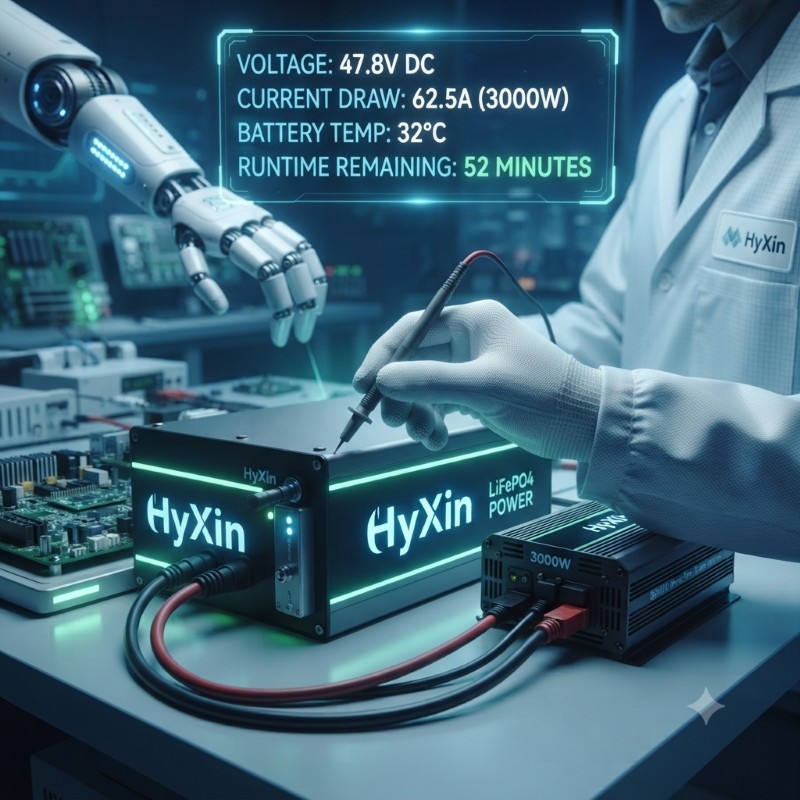
3000W ÷ 48V ≈ 62.5A
Nufin wannan:
A 3000W inverter operating at full load requires approximately:
62.5A continuous input current.
Considering inverter efficiency:
Zaton 90% inganci:
3000W ÷ 48V ÷ 0.9 ≈ 69A
Saboda haka, the actual requirement is approximately:
65–70A continuous current.
3. Can a 48V 50Ah LiFePO4 Battery Meet the Current Requirement?
The answer depends on the battery design.
Different 48V 50Ah batteries have different BMS ratings and discharge capabilities.
| Battery Configuration | Maximum Continuous Discharge | Can It Support a 3000W Inverter? |
|---|---|---|
| 50A BMS | 50A | Not recommended |
| 60A BMS | 60A | Close to the limit |
| 80A BMS | 80A | Suitable |
| 100A BMS | 100A | Yaba |
Saboda haka:
Ƙarfin baturi (50Ah) is not the only determining factor. Maximum discharge current is the key factor.
4. Key Factors Affecting a 48V 50Ah Battery Powering a 3000W Inverter
1. BMS Discharge Capability
Tsarin Gudanar da Baturi (BMS) controls:
- Kariya fiye da yanzu
- Kariyar fiye da caji
- Temperature protection
- Daidaitawar salula
If the BMS limits output to 50A, even a stronger battery cell cannot deliver enough power.
For a 3000W inverter system, the recommended requirement is:
BMS continuous discharge current ≥70A
An ideal configuration would be:
80A–100A BMS.
2. Cell Discharge Rate
LiFePO4 cells are available with different discharge capabilities.
Misali:
1C fitarwa:
50Ah × 1C = 50A
2C fitarwa:
50Ah × 2C = 100A
High-rate cells can provide greater instant power output.
3. Inverter Startup Surge Power
Many devices require significantly higher power during startup.
Examples include:
- Masu firiji
- Water pumps
- Motoci
- Na'urorin sanyaya iska
Startup power can reach:
2–3 times the rated power.
A 3000W inverter may require:
6000W or higher peak output.
Saboda haka, the battery must support high surge current.
5. How Long Can a 48V 50Ah Battery Run a 3000W Inverter?
Battery energy:2400Wh
Inverter inganci:90%
Makamashi mai amfani: 2400ku × 0.9 ≈ 2160Wh
At a 3000W load:
Operating time: 2160Wh ÷ 3000W ≈ 0.72 hours
Kamar: 40–45 minutes.
Saboda haka:
A 48V 50Ah LiFePO4 battery can power a 3000W inverter, but it cannot provide long-term operation at full power.
6. Estimated Runtime Under Different Loads
| Load Power | Kiyasta lokacin gudu |
|---|---|
| 300W device | Kewaye 7 hours |
| 500W device | Kewaye 4 hours |
| 1000W device | Kewaye 2 hours |
| 2000W device | Kewaye 1 awa |
| 3000W device | Kewaye 40 mintuna |
Lokacin gudu na gaske ya dogara:
- Zazzabi
- tsufan baturi
- System efficiency
7. Suitable Applications for a 48V 50Ah LiFePO4 Battery with a 3000W Inverter
Suitable Applications:
Off-Grid Solar Systems
Misalai:
- Small residential energy storage
- Outdoor power systems
- Solar backup systems
RV Applications
Taimakawa:
- Small appliances
- Haske
- Na'urorin lantarki
Industrial Backup Power
Misalai:
- Communication equipment
- Control systems
- Automation devices
Less Suitable Applications:
Long-term operation of:
- Na'urorin sanyaya iska
- High-power heaters
- Electric ovens
because the battery capacity is limited.
8. How to Select the Right 48V LiFePO4 Battery for a 3000W Inverter
Recommended configuration:
| Misali | Takardar yabo |
|---|---|
| Wutar lantarki | 48V |
| Iyawa | 50Ah or higher |
| BMS Rating | ≥80A |
| Battery Cell | High-rate LiFePO4 |
| Zagayowar Rayuwa | 3000–6000 cycles |
| Matakin kariya | IP65 ko mafi girma |
For longer operating time:
A: 48V 100Ah LiFePO4 baturi ana bada shawarar.
Energy capacity: 48V × 100Ah = 4800Wh
Providing approximately twice the runtime.
9. HyXin’s Value in 48V LiFePO4 Battery Solutions
As a professional new energy battery solution provider, HYXin focuses on high-performance LiFePO4 battery packs, customized lithium battery systems, and intelligent BMS management solutions.
For applications including:
- 48V energy storage systems
- Solar inverter systems
- Motocin lantarki
- Off-grid power solutions
HYXin provides:
- High-rate LiFePO4 cell selection
- High-current BMS design
- Customized battery structures
- Long-cycle-life battery systems
By accurately matching battery capacity, discharge capability, and application requirements, HYXin helps customers build safer, mafi inganci, and more reliable energy systems.
Ƙarshe
Don haka, iya a 48V 50Ah LiFePO4 battery power a 3000W inverter?
Amsar ita ce:
Ee, but only under the right conditions:
- The BMS continuous discharge capability should be above 70A
- The battery cells must support sufficient discharge rates
- The inverter should operate efficiently
- The load should not exceed the battery’s long-term capability
For short-term 3000W output, a high-quality 48V 50Ah LiFePO4 battery can meet the requirement.
Duk da haka, for continuous operation of 3000W equipment, a larger battery system is recommended:
48V 100Ah or higher LiFePO4 battery.
With the rapid development of energy storage, solar power, and smart devices, high-safety, high-efficiency, and intelligent LiFePO4 battery systems will become an essential energy foundation for residential, sana'a, da aikace-aikacen kashe-grid.

About HyXin
HyXin is a professional battery solution provider specializing in customized lithium battery packs, LiFePO4 battery systems, intelligent BMS solutions, and advanced energy storage technologies.
With expertise in battery design, high-current discharge solutions, and application-specific customization, HyXin provides reliable energy solutions for solar storage systems, motocin lantarki, kayan aiki na kasuwanci, da aikace-aikacen masana'antu.
Through continuous innovation and engineering development, HyXin is committed to delivering safer, smarter, and more efficient battery solutions for the global new energy market.
Da fatan za a tuntuɓi mu don ƙarin bayani.