
하드웨어 결함을 다루는 표준 운영 절차, 매개변수 설정, and Deep Wake-Up
리튬철인산염 ($\텍스트{LiFePO}_4$) 배터리는 뛰어난 수명으로 유명합니다., 열 안정성, 딥 사이클링 기능. A standard 48V 50Ah $\텍스트{LiFePO}_4$ 배터리 팩 (typically configured in a $16\텍스트{에스}$ 3.2V 공칭 셀을 사용한 배열) 통신 분야에 널리 배포됩니다., 태양 에너지 저장, and light electric vehicles. 하지만, when such a pack fails to hold a charge, it disrupts critical operations.
Diagnosing and resolving this issue requires a systematic, data-driven approach, examining everything from external charging parameters to internal cell balance and Battery Management System (BMS) integrity.
1. Initial Diagnostic Framework & External Factors
Before dismantling the battery pack or suspecting permanent cell degradation, technicians must rule out environmental and peripheral equipment failures.
-
Ambient Temperature Restrictions: $\텍스트{LiFePO}_4$ chemistry possesses strict thermal boundaries. Charging below $0^원텍스트{기음}$ ($32^원텍스트{에프}$) without low-temperature cutoff protection triggers lithium plating on the anode, causing irreversible capacity loss and internal short circuits.
-
Charger Output Verification: A mismatch between the charger’s output profile and the battery requirements will prevent proper charging. A 16-series 48V $\텍스트{LiFePO}_4$ battery requires a bulk/absorption voltage typically between 56.8V and 58.4V (3.55V to 3.65V per cell). If a standard 48V lead-acid charger is used, its float voltage is too low, and its desulfurization mode may trigger BMS fault protections.
Diagnostic Parameter Benchmarks
| 매개 변수 | Normal Operating Range | Fault Threshold / Warning Sign |
| Charger Output Voltage | $56.8\텍스트{V} – 58.4\텍스트{V}$ | $< 54.0\텍스트{V}$ (Under-voltage output) |
| BMS Cutoff Voltage (Over-Charge) | $3.65\텍스트{V} – 3.80\텍스트{V}$ 셀당 | $> 3.90\텍스트{V}$ (Cell runaway risk) |
| BMS Cutoff Voltage (Under-Discharge) | $2.50\텍스트{V} – 2.80\텍스트{V}$ 셀당 | $< 2.00\텍스트{V}$ (Deep sleep / Lockout) |
| 작동 온도 (요금) | $0^원텍스트{기음}$ 에게 $45^원텍스트{기음}$ | $< 0^원텍스트{기음}$ (Plating risk) |
| 내부저항 (Healthy Pack) | $< 30\,\텍스트{m}\Omega$ (Total pack) | $> 80\,\텍스트{m}\Omega$ (Degraded / High resistance) |
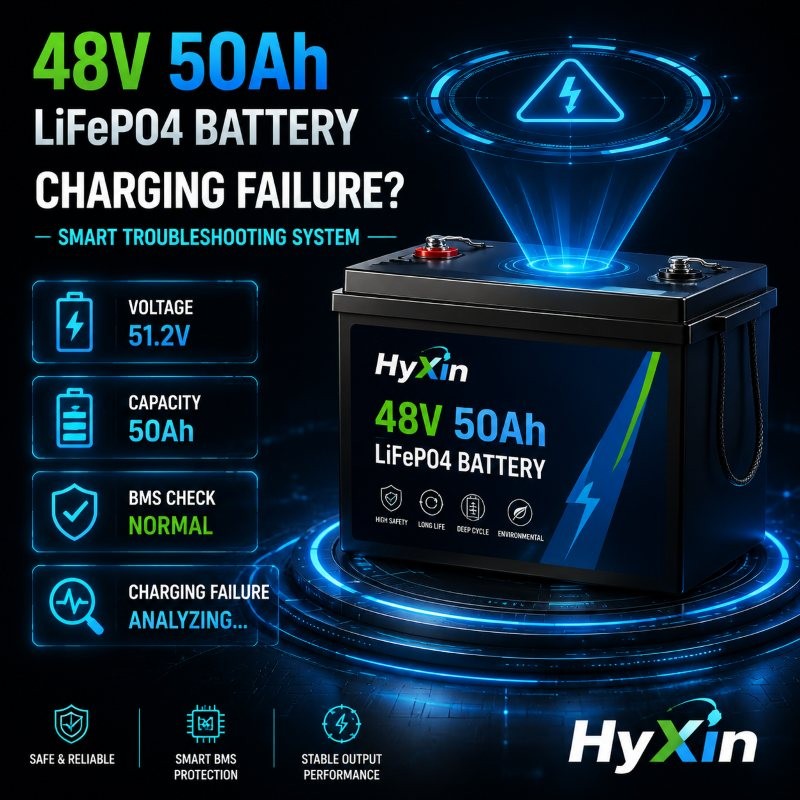

2. BMS Protection and “Sleep Mode” Recovery
The Battery Management System is the brain of the 48V 50Ah pack, designed to disconnect the circuit during over-voltage, 저전압, 과전류, or short-circuit events.
-
Under-Voltage Lockout: If a 48V pack discharges below its absolute minimum threshold (일반적으로 주위에 $40\텍스트{V}$ 에게 $44\텍스트{V}$, 또는 $2.5\텍스트{V}$ 셀당), the BMS enters a protection shutdown state and cuts off the discharge/charge MOSFETs. In this state, standard smart chargers may read “0V” at the terminals and refuse to initiate a charge cycle because they detect no opposing voltage.
-
Recovery Procedure: To wake a sleeping BMS, technicians must apply a dedicated lithium charger with a “0V wake-up” 또는 “forced charge” function, or connect a compatible power supply capable of delivering a controlled, low-current pre-charge until individual cell voltages rise above the $2.8\텍스트{V}$ recovery threshold.
3. Internal Cell Imbalance and Capacity Degradation
If external variables and BMS settings are normal, the root cause usually lies within the internal $16\텍스트{에스}$ cell architecture.
The Weak-Link Phenomenon in Series Strings
ㅏ 48V 50Ah pack relies on the uniform capacity of 16 individual cells connected in series. If even a single cell degrades, exhibits higher internal resistance, or suffers from self-discharge, it reaches its full charge state ($\sim 3.65\text{V}$) or empty state ($\sim 2.5\text{V}$) long before the rest of the pack.
-
Premature Charging Cutoff: 충전 중, if Cell #7 reaches $3.65\텍스트{V}$ prematurely due to capacity fade (예를 들어, dropping from 50Ah to 35Ah), the BMS immediately shuts down charging to protect that specific cell. 따라서, the overall 48V pack remains only partially charged, manifesting as a failure to hold energy.
-
Cell Balancing Limitations: Standard BMS balancing currents are relatively small (대개 $30\텍스트{엄마}$ 에게 $100\텍스트{엄마}$). If the delta voltage between cells exceeds $100\텍스트{mV}$, passive balancing cannot correct the drift during a standard charging window, requiring manual top-balancing.
4. Step-by-Step Troubleshooting Protocol
-
단계 1: Terminal Voltage Measurement
Measure the open-circuit voltage (OCV) across the main positive and negative terminals using a calibrated digital multimeter.
-
Reading is $48\텍스트{V} – 54\텍스트{V}$: Pack is operational; proceed to capacity testing.
-
Reading is $0\텍스트{V}$: BMS has tripped via protection mode or internal fuse is blown.
-
-
단계 2: Check Fuse and Continuity
Inspect the internal or external main fuse. High current spikes can blow the master fuse, isolating the cells from the external terminals while the internal cells remain intact.
-
단계 3: Access and Measure Individual Cell Voltages
Carefully open the protective casing (observing anti-static and insulated tool protocols) to access the BMS balancing harness. Measure the voltage of each of the 16 individual cells.
-
Healthy Delta: Cell voltage variance should be $< 30\텍스트{mV}$ at full charge.
-
Faulty Delta: Variance $> 200\텍스트{mV}$ indicates severe cell imbalance or capacity degradation.
-
-
단계 4: Perform Manual Top-Balancing
If imbalance is confirmed, disconnect the BMS and charge individual low-voltage cells using a single-cell 3.65V bench power supply until all cells match precisely, then reset the BMS cycle.
결론
Troubleshooting and repairing a 48V 50Ah LiFePO4 battery that fails to hold a charge relies on a step-by-step, inside-out approach. Starting with ruling out external ambient temperature limits and charger output compatibility, moving on to identifying BMS low-voltage protection and “sleep” states, and finally diving into the voltage differential and capacity degradation analysis of the internal $16\텍스트{에스}$ series cells, every step requires precise data support. Through standardized multimeter measurements, fuse inspections, individual cell delta diagnostics, and necessary manual top-balancing procedures, technicians can efficiently pinpoint the root cause, maximize the restoration of the battery pack’s energy storage performance and service lifespan, and ensure the safe and reliable operation of the energy storage system.
연락주세요 우리를 자세한 내용은!