
Permezz 2026, Vettura Elettrika globali (EV) penetrazzjoni qasmet punt kritiku ta 'ċaqliq. Hekk kif ir-restrizzjonijiet tal-kapaċità tal-grilja fl-ibliet Ewropej u Ċiniżi Tier-1 isiru dejjem aktar prominenti, il-limitazzjonijiet ta 'munzelli ta' ċċarġjar fissi twieldu l- “Iċċarġjar mobbli” settur. Il- 25.6V 300Ah Lithium Iron Phosphate (LFP) batterija, bil-kurva unika tal-ispiża u l-profil tas-sigurtà tagħha, has emerged as the most vital “modular unit” in this field.
I. Technical Underlying Logic: The Tug-of-War Between Energy Density and Voltage Platforms
1.1 Il- “Golden Ratio” of Energy and Physical Specs
The rated energy of this battery specification is 7.68 kWh. Under 2026 CTP (Cell-to-Pack) teknoloġija, the total unit weight has been reduced to 55kg–70kg. This weight range is strategically significant: it sits at the perfect equilibrium between “lightweight mobility” u “stable range.” While insufficient for a full charge, it provides a “Golden Rescue Distance” ta 40–50 km within 15 minutes—a lifesaver in urban traffic.
1.2 Low-Voltage Conversion Challenges: The Necessity of SiC (Silicon Carbide)
As a 25.6V low-voltage system, it faces a natural voltage gap against mainstream 400V/800V EV architectures.
-
Traditional Pain Point: Massive boost ratios cause severe heat spikes during conversion, typically resulting in over 15% efficiency loss.
-
2026 Soluzzjoni: Integration of Silicon Carbide (SiC) high-frequency boost modules is now mandatory. SiC modules push conversion efficiency above 92%. Although this adds approximately 12% to upfront hardware costs, the resulting efficiency and miniaturization are prerequisites for commercializing mobile stations.
II. Market Competition: Why LFP Remains the Top Choice?
2.1 Strictly Controlled LCOE (Levelized Cost of Energy)
Fil 2026, while solid-state batteries are beginning to enter premium niches, LFP still commands over 70% of the storage market.
-
Maturità tal-Katina tal-Provvista: The 25.6V 300Ah spec has become a standardized industry benchmark, granting massive procurement leverage.
-
Economic Advantage: Compared to NCM (Nickel Cobalt Manganese) batteriji, LFP’s cost per Wh is roughly 25% aktar baxxi. In high-turnover mobile charging models, the Return on Investment (ROI) period can be shortened by 6–8 months.
2.2 2026 EU Battery Regulation and ESG Compliance
With the full implementation of the EU Battery Regulation (2023/1542) fi 2026, il Passaport tal-batterija has become the mandatory ticket to entry.
-
Eco-Friendly Profile: LFP contains no cobalt or nickel. Its superior carbon footprint tracking data meets the rigorous ESG (Environmental, Social, and Governance) audit standards in Europe, clearing the legal path for global brand expansion.
III. Deep Scenario Penetration: From Emergency to Service-Oriented
3.1 Robots Mobbli Awtonomi (AMR): Il- “Delivery Riders” of Garages
This is the core battlefield for this battery specification.
-
Problem Solved: Expanding power capacity in CBD underground garages is prohibitively expensive.
-
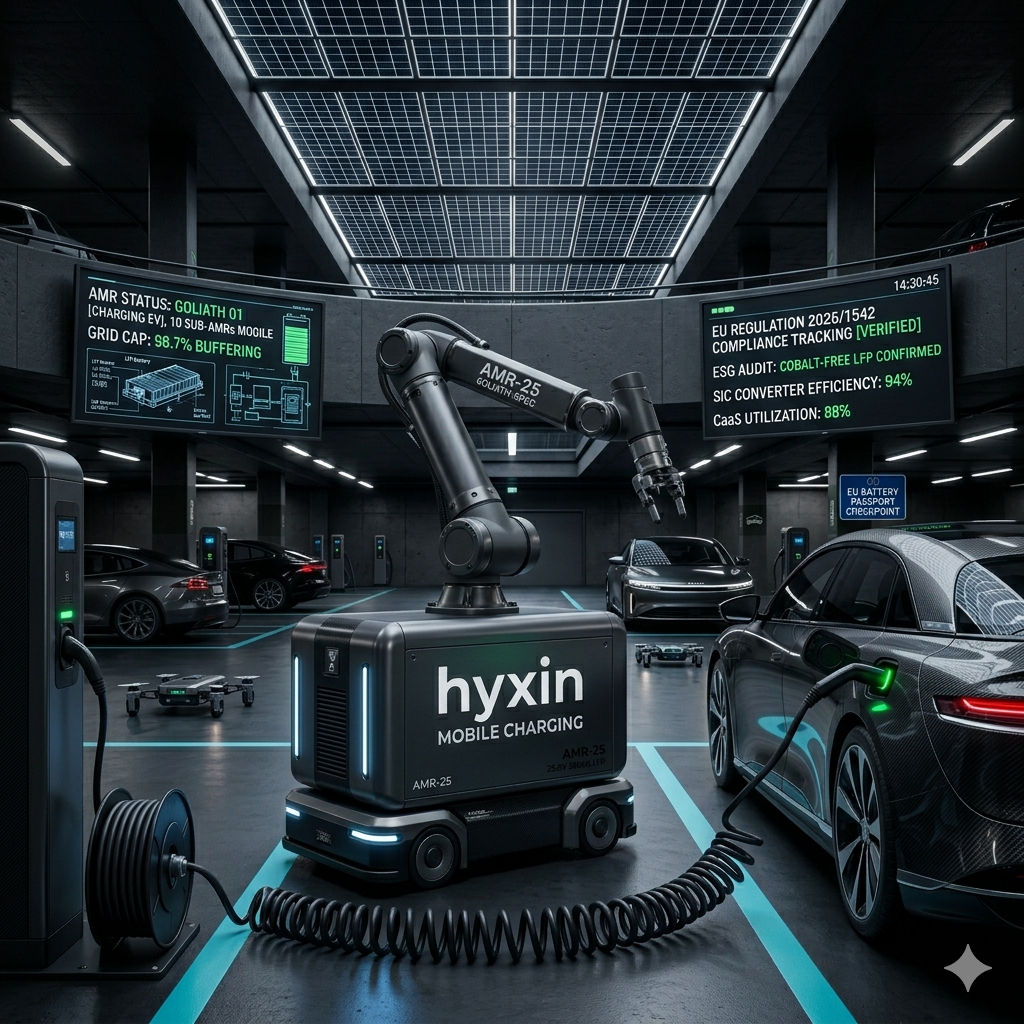
Operational Model: AMRs equipped with 25.6V 300Ah modules self-charge via standard outlets during off-peak hours and cruise the garage during peaks. Their compact 1:1 design ensures agility in narrow parking bays.
3.2 Il- “Last 10%” of Roadside Assistance
EV breakdowns on highways or in extreme winter weather cause significant urban congestion.
-
Rescue Kit Form Factor: Encapsulating this battery module into a ruggedized, portable case makes it a standard tool for roadside assistance vehicles. It is more than just a charger; it acts as a “Jump Starter” to release electronic handbrakes or power up blacked-out dashboards caused by deep discharge.
IV. Risk Assessment and Mitigation
Despite the bright outlook, this solution must address two “ceilings”:
-
Charging Power Limits: Limited by the thermal effects of 25.6V terminal current, this system struggles with ultra-high-power fast charging. It must be clearly positioned as “DC 20kW-level Emergency Supplemental Power,” rather than a replacement for fixed piles.
-
Ġestjoni Termali: During discharge rates above 1C, the 25.6V system draws up to 300A. This places extreme demands on BMS (Sistema ta 'ġestjoni tal-batteriji) temperature algorithms and physical heat dissipation.
V. Strategic Recommendations and Future Outlook
5.1 Scalability and Modular Architecture
Developers should avoid rigid “monolithic” designs in favor of “Parallel Architectures.”
-
Single Module: Targets light e-mopeds, ikkampjar, and basic emergency rescue.
-
Quad-Module Parallel: Forms a 30kWh mobile station capable of servicing passenger EVs with meaningful fast-charging sessions.
5.2 Aesthetics and Brand Language
In the 2026 suq, 50% of product appeal comes from design.
-
Design Proposal: Adopt a minimalist high-tech black industrial aesthetic, complemented by large LED status matrices. This visual impact not only boosts price premiums but also establishes a “tech totem” within urban landscapes and social media.
Konklużjoni
The 25.6V 300Ah LFP battery is not a “perfect” energy carrier, but it is an “exceedingly smart” commercial entry point. By bypassing the complexity of high-voltage systems and leveraging the safety of LFP, it precisely hits the blue ocean of urban mobile charging. In the energy landscape of 2026 and beyond, this modular, low-barrier, high-cycle solution will be an indispensable link in building resilient urban power networks.
Introduzzjoni: Il- “Capillaries” of the Mobile Charging Era
Permezz 2026, Vettura Elettrika globali (EV) penetrazzjoni qasmet punt kritiku ta 'ċaqliq. Hekk kif ir-restrizzjonijiet tal-kapaċità tal-grilja fl-ibliet Ewropej u Ċiniżi Tier-1 isiru dejjem aktar prominenti, il-limitazzjonijiet ta 'munzelli ta' ċċarġjar fissi twieldu l- “Iċċarġjar mobbli” settur. Il- 25.6V 300Ah Lithium Iron Phosphate (LFP) batterija, bil-kurva unika tal-ispiża u l-profil tas-sigurtà tagħha, has emerged as the most vital “modular unit” in this field.
I. Technical Underlying Logic: The Tug-of-War Between Energy Density and Voltage Platforms
1.1 Il- “Golden Ratio” of Energy and Physical Specs
The rated energy of this battery specification is 7.68 kWh. Under 2026 CTP (Cell-to-Pack) teknoloġija, the total unit weight has been reduced to 55kg–70kg. This weight range is strategically significant: it sits at the perfect equilibrium between “lightweight mobility” u “stable range.” While insufficient for a full charge, it provides a “Golden Rescue Distance” ta 40–50 km within 15 minutes—a lifesaver in urban traffic.
1.2 Low-Voltage Conversion Challenges: The Necessity of SiC (Silicon Carbide)
As a 25.6V low-voltage system, it faces a natural voltage gap against mainstream 400V/800V EV architectures.
-
Traditional Pain Point: Massive boost ratios cause severe heat spikes during conversion, typically resulting in over 15% efficiency loss.
-
2026 Soluzzjoni: Integration of Silicon Carbide (SiC) high-frequency boost modules is now mandatory. SiC modules push conversion efficiency above 92%. Although this adds approximately 12% to upfront hardware costs, the resulting efficiency and miniaturization are prerequisites for commercializing mobile stations.
II. Market Competition: Why LFP Remains the Top Choice?
2.1 Strictly Controlled LCOE (Levelized Cost of Energy)
Fil 2026, while solid-state batteries are beginning to enter premium niches, LFP still commands over 70% of the storage market.
-
Maturità tal-Katina tal-Provvista: The 25.6V 300Ah spec has become a standardized industry benchmark, granting massive procurement leverage.
-
Economic Advantage: Compared to NCM (Nickel Cobalt Manganese) batteriji, LFP’s cost per Wh is roughly 25% aktar baxxi. In high-turnover mobile charging models, the Return on Investment (ROI) period can be shortened by 6–8 months.
2.2 2026 EU Battery Regulation and ESG Compliance
With the full implementation of the EU Battery Regulation (2023/1542) fi 2026, il Passaport tal-batterija has become the mandatory ticket to entry.
-
Eco-Friendly Profile: LFP contains no cobalt or nickel. Its superior carbon footprint tracking data meets the rigorous ESG (Environmental, Social, and Governance) audit standards in Europe, clearing the legal path for global brand expansion.
III. Deep Scenario Penetration: From Emergency to Service-Oriented
3.1 Robots Mobbli Awtonomi (AMR): Il- “Delivery Riders” of Garages
This is the core battlefield for this battery specification.
-
Problem Solved: Expanding power capacity in CBD underground garages is prohibitively expensive.
-
Operational Model: AMRs equipped with 25.6V 300Ah modules self-charge via standard outlets during off-peak hours and cruise the garage during peaks. Their compact 1:1 design ensures agility in narrow parking bays.
3.2 Il- “Last 10%” of Roadside Assistance
EV breakdowns on highways or in extreme winter weather cause significant urban congestion.
-
Rescue Kit Form Factor: Encapsulating this battery module into a ruggedized, portable case makes it a standard tool for roadside assistance vehicles. It is more than just a charger; it acts as a “Jump Starter” to release electronic handbrakes or power up blacked-out dashboards caused by deep discharge.
IV. Risk Assessment and Mitigation
Despite the bright outlook, this solution must address two “ceilings”:
-
Charging Power Limits: Limited by the thermal effects of 25.6V terminal current, this system struggles with ultra-high-power fast charging. It must be clearly positioned as “DC 20kW-level Emergency Supplemental Power,” rather than a replacement for fixed piles.
-
Ġestjoni Termali: During discharge rates above 1C, the 25.6V system draws up to 300A. This places extreme demands on BMS (Sistema ta 'ġestjoni tal-batteriji) temperature algorithms and physical heat dissipation.
V. Strategic Recommendations and Future Outlook
5.1 Scalability and Modular Architecture
Developers should avoid rigid “monolithic” designs in favor of “Parallel Architectures.”
-
Single Module: Targets light e-mopeds, ikkampjar, and basic emergency rescue.
-
Quad-Module Parallel: Forms a 30kWh mobile station capable of servicing passenger EVs with meaningful fast-charging sessions.
5.2 Aesthetics and Brand Language
In the 2026 suq, 50% of product appeal comes from design.
-
Design Proposal: Adopt a minimalist high-tech black industrial aesthetic, complemented by large LED status matrices. This visual impact not only boosts price premiums but also establishes a “tech totem” within urban landscapes and social media.

Konklużjoni
The 25.6V 300Ah LFP battery is not a “perfect” energy carrier, but it is an “exceedingly smart” commercial entry point. By bypassing the complexity of high-voltage systems and leveraging the safety of LFP, it precisely hits the blue ocean of urban mobile charging. In the energy landscape of 2026 and beyond, this modular, low-barrier, high-cycle solution will be an indispensable link in building resilient urban power networks.
Għal aktar informazzjoni, jekk jogħġbok ikkuntattja lilna.