
AGV and AMR robots are becoming an important part of modern factories, warehouses, logistics centers, and smart manufacturing systems. As robots move toward longer operating hours and higher utilization, battery selection is no longer a simple question of choosing the largest capacity.
The battery directly affects runtime, 充電のダウンタイム, robot weight, 安全性, 耐用年数, and total operating cost.
それで, how should companies choose the right battery for an AGV or AMR?
1. The AGV and AMR Market Is Moving Toward Higher Utilization
The demand for mobile robots continues to grow.
According to Interact Analysis, the global mobile robot market is forecast to grow at an average annual rate of around 19% から 2024 に 2030, reaching approximately $14 billion in 2030. The research also points to a continued transition from traditional AGVs toward more flexible AMR systems.
Yano Research Institute estimated global AGV and AMR shipments at approximately 286,235 units in 2025, with the market expected to reach about 1.38 million units by 2030.
These trends are important for battery suppliers because higher robot deployment means higher requirements for:
- 稼働時間の延長
- より速い充電
- More charging cycles
- Better battery management
- メンテナンスの低下
- Reliable fleet operation
In other words, the battery is becoming part of the robot’s overall productivity system.
2. Start With the Robot’s Actual Power Consumption
The first step in battery selection is understanding the robot’s real operating profile.
Key parameters include:
| パラメーター | What to Check |
|---|---|
| 電圧 | 24V, 48V or another system voltage |
| Average Power | Normal operating consumption |
| Peak Power | Acceleration, lifting and climbing |
| ランタイム | Required operating hours |
| Payload | Robot + maximum load |
| Working Cycle | Continuous, intermittent or 24/7 |
| 充電 | Full charging, opportunity charging or swapping |
Average power alone is not enough.
An AMR may consume relatively little energy while cruising, but power demand can increase significantly during acceleration, lifting, turning, or transporting a heavy load.
したがって, the battery must support both continuous current and peak current.
3. How Much Battery Capacity Does an AGV or AMR Need?
A simple starting point is:
Required Energy = Average Power × Operating Time
例えば, if an AMR consumes an average of 500W and needs to operate for 8 時間:
500W × 8h = 4kWh
しかし, the battery should not normally be selected at exactly 4kWh.
Designers should also consider:
- BMS limits
- Conversion losses
- Battery aging
- 温度
- Safety margin
- Usable depth of discharge
A more practical approach is to calculate the energy requirement based on the robot’s real duty cycle rather than its theoretical maximum.
4. Real-World Robots Show Why Runtime Matters
Current commercial AMRs demonstrate that operating time and charging strategy are closely connected.
例えば, OMRON’s LD-250 can carry up to 250 kg and provides up to 13 hours of operation without payload or 10 hours at full payload. Its specified charging time from 20% に 80% is approximately 2 hours and 10 分.
Its larger MD-650/900 platform is rated for up to 650–900 kg payload, with approximately 10 hours of runtime without payload and 8 hours at full payload, while the 20–80% charging time is listed at only about 19.6 分.
This comparison highlights an important point:
Battery selection is not only about capacity. Charging speed and operating strategy can be equally important.
5. LiFePO4 Is a Strong Choice for Many AGV and AMR Applications
For industrial mobile robots, lithium-ion batteries have increasingly become the preferred technology because of their combination of energy density, charging performance, サイクル寿命, and maintenance requirements.
Among lithium chemistries, LiFePO4 (LFP) is particularly attractive for many AGV and AMR applications.
Its key advantages include:
- Good thermal stability
- Strong safety characteristics
- 長いサイクル寿命
- Low maintenance
- Good tolerance for frequent charging
- Competitive total cost of ownership
For robots operating in warehouses and factories, these characteristics can be more important than achieving the highest possible energy density.
NMC can still be attractive where weight and physical size are the highest priorities, but LFP is often a practical starting point for industrial mobile platforms.
6. Charging Strategy Can Be More Important Than Battery Size
Traditional battery thinking often follows:
Work → Battery Empty → Recharge → Work Again
For modern AMR fleets, a different approach is becoming increasingly common:
Work → Short Charge → Work → Short Charge
This is known as opportunity charging.
例えば, OTTO AMRs use an opportunistic charging strategy that sends robots to charge between jobs. The company reports charging times from 10% に 90% ranging from 18 minutes to 60 分, depending on the AMR model.
This approach can reduce downtime without requiring an extremely large battery.
For high-utilization warehouses, the best battery may therefore be one that supports frequent partial charging and fast recharge, rather than simply having the largest kWh capacity.
7. Battery Swapping Can Increase Fleet Availability
Another solution is modular battery swapping.
The basic concept is:
Battery A → Robot Working
Battery A → Charging
Battery B → Robot Working
This can be especially useful for:
- 24/7 warehouses
- Manufacturing plants
- Distribution centers
- Heavy-duty AGVs
- Large robot fleets
Instead of making one battery extremely large, operators can maintain several battery packs and rotate them according to production requirements.
This can also simplify maintenance and fleet management.
8. BMS and Communication Are Critical
A modern AGV/AMR battery is not simply a collection of battery cells.
の バッテリー管理システム (BMS) is responsible for monitoring and protecting the battery.
Important functions include:
- 過充電保護
- 充電過剰保護
- 過電流保護
- 短絡保護
- 温度監視
- セルバランシング
- SOC monitoring
- SOH monitoring
For smart robots, communication is also important.
A battery may need to communicate with the robot controller or fleet-management system through interfaces such as CAN or RS485.
This allows the robot to know when the battery needs charging and helps prevent unexpected shutdowns.
9. Don’t Forget Weight, Size and Operating Environment
Battery capacity cannot be considered independently from physical design.
A larger battery provides more energy, but it also adds:
重さ + 料金 + Space Requirements
Additional battery weight can increase the energy required for movement, particularly for mobile robots that accelerate frequently or operate on ramps.
The operating environment is also important.
For outdoor AGVs or robots working in cold environments, battery performance at low temperatures and charging protection need special consideration.
For indoor warehouse AMRs, 振動, ほこり, 湿度, operating temperature, and charging frequency should also be included in the battery specification.
10. A Practical AGV/AMR Battery Selection Checklist
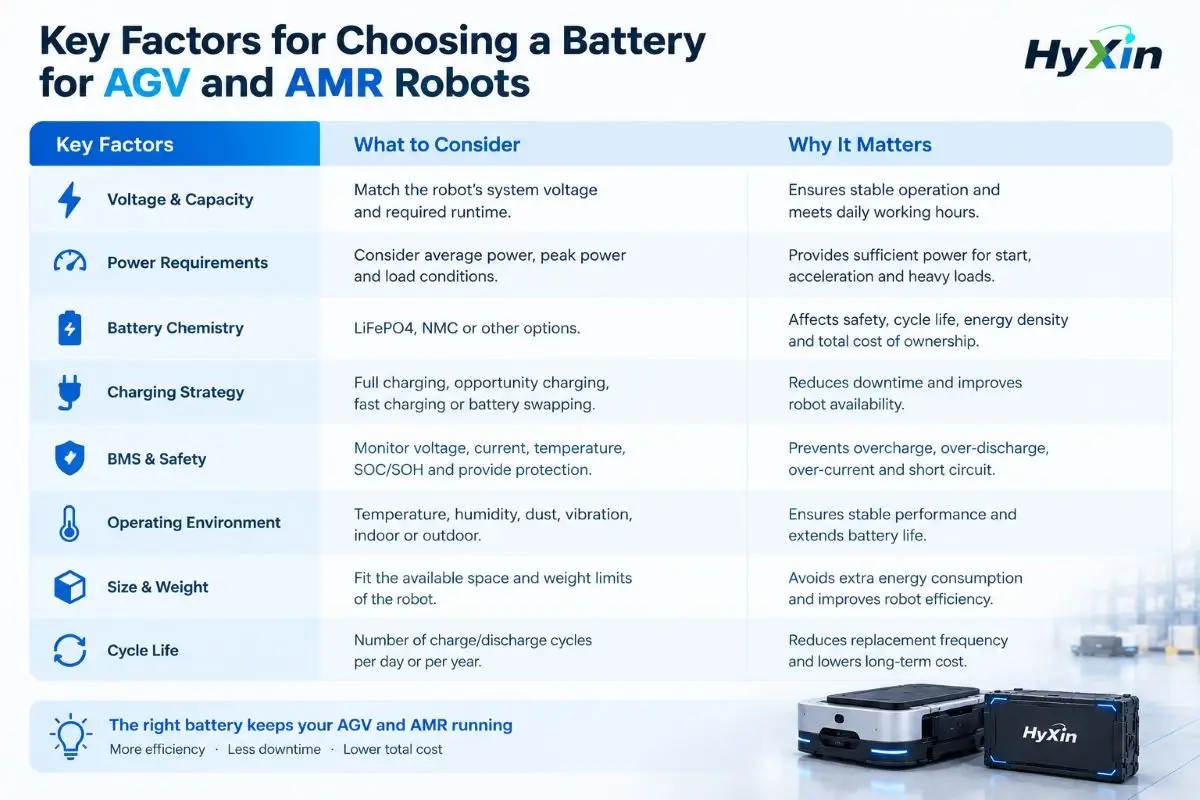
Before contacting a battery supplier, define these parameters:
| アイテム | Recommended Question |
|---|---|
| 電圧 | What voltage does the robot require? |
| 容量 | How many kWh are needed per working cycle? |
| Peak Current | What is the maximum instantaneous load? |
| ランタイム | How many hours should the robot operate? |
| 化学 | LFP, NMC or another chemistry? |
| 充電 | Full charge, opportunity charge or swap? |
| BMS | What protection and communication functions are required? |
| 寸法 | What space is available for the battery? |
| 重さ | What is the maximum acceptable weight? |
| 環境 | What temperatures and conditions will the robot face? |
| サイクルライフ | How many cycles are expected each year? |
This information gives a battery manufacturer enough data to develop a more accurate solution.

11. どこ ハイシン Fits Into AGV and AMR Battery Solutions
For AGV and AMR manufacturers, a standard battery is not always the best solution.
ハイシン focuses on LiFePO4 batteries and customized battery-pack solutions, allowing battery specifications to be matched to the requirements of different machines and applications. Its customization process covers battery specifications, pack design, prototyping, and production.
For an AGV or AMR project, HyXin can evaluate key parameters such as:
電圧 + 容量 + Peak Current + ランタイム + BMS + 寸法 + Charging Requirements
This approach is particularly useful when the robot requires a non-standard battery size, specific communication functions, or a customized operating profile.
The goal is not simply to provide a battery with more capacity, but to create a battery system that works efficiently with the entire robot.
結論
Choosing a battery for an AGV or AMR robot is ultimately a balance between エネルギー, 力, 重さ, 安全性, charging speed, サイクル寿命, 総所有コスト.
For many industrial applications, LiFePO4 offers a practical combination of safety, 長いサイクル寿命, and reliable performance.
しかし, there is no universal battery that is perfect for every robot.
A lightweight warehouse AMR, ある 250 kg transport robot, and a heavy-duty AGV may require completely different battery configurations.
As AGV and AMR fleets continue to expand, the battery is becoming an increasingly important part of robot system design.
The right question is therefore not:
“How large should the battery be?”
It is:
“How can the battery provide the required energy and power while keeping the robot productive for as much of the working day as possible?”
For robot manufacturers, making this decision early—and working with a battery supplier capable of customization—can improve runtime, reduce downtime, and lower the long-term operating cost of the entire fleet.
詳細については, 連絡してください 私たち.