This document specifies the terms and definitions, technical requirements, test methods, inspection rules, marking, packaging, transportation, and storage1 of lithium-ion batteries for industrial mobile robots (hereinafter referred to as “batteries”).
This document applies only to lithium-ion batteries for industrial mobile robots.
2. Normative References
The following documents are referred to in the text in such a way that some or all of their content constitutes requirements of this document. For dated references, only the edition cited applies. For undated references, the latest edition of the referenced document (including any amendments) applies.
- GB/T 17799.2 Electromagnetic compatibility – Generic standards – Immunity test for industrial environments
- GB 17799.4 Electromagnetic compatibility – Generic standards – Emission standard for industrial environments
- GB 38031-2020 Safety requirements for power batteries for electric vehicles
- UL 1642 Standard for Lithium Batteries
- UL 2580 Standard for Batteries for Use in Electric Vehicles
- IEC(EN) 62133 Secondary cells and batteries containing alkaline or other non-acid electrolytes – Safety requirements for portable sealed secondary cells, and for batteries made from them, for use in portabl applications
- IEC 62619 Secondary cells and batteries containing alkaline or other non-acid electrolytes – Safety requirements for secondary lithium cells and batteries, for use in industrial applications
- T/SSITS 101-2020 Terminology for Industrial Mobile Robots
3. Terms and Definitions
For the purposes of this document, the terms and definitions given in T/SSITS 101-2020 and the following apply.
3.1 Secondary Cell (Lithium-ion)
Basic unit device containing lithium ions that can convert chemical energy and electrical energy mutually. Typically includes electrodes, separators, electrolytes, cases, and terminals, and is designed to be rechargeable.
3.2 Battery Management System (BMS)
General term for a circuit system that controls, manages, detects, or calculates electrical and thermal parameters of a battery, and can upload relevant information.
3.3 Lithium-ion Battery for Industrial Mobile Robot
A device that provides electrical energy specifically for industrial mobile robots, composed of multiple lithium-ion secondary cells combined according to voltage, size, polarity terminal arrangement, capacity, and rate characteristics, and containing a battery management system.
3.4 Rated Capacity
The capacity value of a battery cell or battery measured and declared by the manufacturer under specified conditions.
3.5 Initial Capacity
The capacity value of a new battery cell or battery measured under the conditions specified by the supplier.
3.6 State-of-Charge (SOC)
The percentage of the capacity that can be released from the current battery cell or battery under the discharge conditions specified by the manufacturer, relative to the actual capacity.
3.7 Capacity Recovery
The ratio of the discharge capacity after a fully charged battery cell or battery is stored at a certain temperature for a certain period and then fully recharged, to the initial capacity.
3.8 Explosion
A sudden release of sufficient energy to generate a pressure wave or ejecta, which may cause structural or physical damage to the surrounding area.
3.9 Fire
Sustained combustion of any part of a battery cell or battery (single flame duration greater than 1s). Sparks and arcing are not considered combustion.
3.10 Leakage
The phenomenon of visible substances leaking from a battery cell or battery to the outside of the test object.
3.11 Housing Crack
Mechanical damage to the battery cell or battery housing caused by internal or external factors, resulting in exposure or overflow of internal substances.
4. Symbols
The following symbols apply to this document.
- I₁: 1h rate discharge current (A), its value is equal to the rated capacity value.
5. Technical Requirements
5.1 General
The battery shall comply with all requirements specified in this standard and the corresponding detailed specifications. In case of inconsistency between the requirements of this standard and related detailed specifications, the related detailed specifications shall prevail.
5.2 Battery Cells
Battery cells must comply with one of the following certifications: national mandatory GB38031, UL1642, UL2580, IEC(EN)62133, or IEC62619.
5.3 Battery
5.3.1 Appearance
When the battery is inspected according to 6.2.1, the appearance shall be free of obvious deformation, cracks, fissures, dents, damage, and rust. The electrode terminals shall be free of rust.
5.3.2 Polarity
When the battery is inspected according to 6.2.2, the terminal polarity markings shall be correct and clear.
5.3.3 Dimensions and Mass
When the battery is inspected according to 6.2.3, the dimensions and mass shall comply with the requirements of the product detailed specifications.
5.3.4 Electrical Performance Requirements
5.3.4.1 Normal Temperature Capacity
After the battery is tested three times according to 6.2.4.1, at least one discharge capacity shall not be less than the rated capacity.
5.3.4.2 Fast Charge Capacity
After the battery is tested according to 6.2.4.2, its discharge capacity shall not be less than 95% of the rated capacity.
5.3.4.3 Low Temperature Capacity
After the battery is tested according to 6.2.4.3, its discharge capacity shall not be less than 60% of the rated capacity.
5.3.4.4 High Temperature Capacity
After the battery is tested according to 6.2.4.4, its discharge capacity shall not be less than 90% of the rated capacity.
5.3.4.5 Charge Retention and Capacity Recovery
After the battery is tested according to 6.2.4.5, its normal temperature charge retention rate shall not be less than 85% of the initial capacity, and the capacity recovery shall not be less than 90% of the initial capacity.7
5.3.4.6 Storage
After the battery is tested according to 6.2.4.6, its capacity recovery shall not be less than 90% of the initial capacity.
5.3.4.7 Cycle Life
When the battery is tested according to 6.2.4.7, the battery cycle life shall not be less than 1000 cycles or comply with the product detailed specifications.
5.3.5 Battery Safety Requirements
5.3.5.1 Insulation Resistance
When the battery is tested for insulation resistance according to 6.2.5.1, the insulation resistance value shall not be less than 2MΩ.
5.3.5.2 Over-Temperature Protection
When the battery is tested for over-temperature according to 6.2.5.2, there shall be no leakage, housing crack, fire, or explosion, and the battery shall stop charging or discharging.
5.3.5.3 Over-Current Protection
When the battery is tested for over-current according to 6.2.5.3, there shall be no leakage, housing crack, fire, or explosion, and the battery shall stop charging or discharging.
5.3.5.4 Over-Charge Protection
When the battery is tested for over-charge according to 6.2.5.4, there shall be no leakage, housing crack, fire, or explosion, and the battery shall cut off the charging circuit.
5.3.5.5 Over-Discharge Protection
When the battery is tested for over-discharge according to 6.2.5.5, there shall be no leakage, housing crack, fire, or explosion, and the battery shall cut off the discharging circuit.
5.3.5.6 External Short Circuit
When the battery is tested for external short circuit according to 6.2.5.6, there shall be no leakage, housing crack, fire, or explosion, and the battery shall cut off the circuit.
5.3.5.7 Vibration
When the battery is tested for vibration according to 6.2.5.7, there shall be no leakage, housing crack, fire, or explosion.
5.3.5.8 Impact
When the battery is tested for impact according to 6.2.5.8, there shall be no leakage, housing crack, fire, or explosion.
5.3.5.9 Drop
When the battery is tested for drop according to 6.2.5.9, there shall be no leakage, housing crack, fire, or explosion.
5.3.5.10 Temperature Shock
When the battery is tested for temperature shock according to 6.2.5.10, there shall be no leakage, housing crack, fire, or explosion.
5.3.5.11 High Altitude Test
When the battery is tested for high altitude according to 6.2.5.11, there shall be no leakage, housing crack, fire, or explosion.
5.3.5.12 Electromagnetic Compatibility
Electromagnetic emissions shall meet the requirements of GB 17799.4.
Electromagnetic immunity shall meet the requirements of GB/T 17799.2.
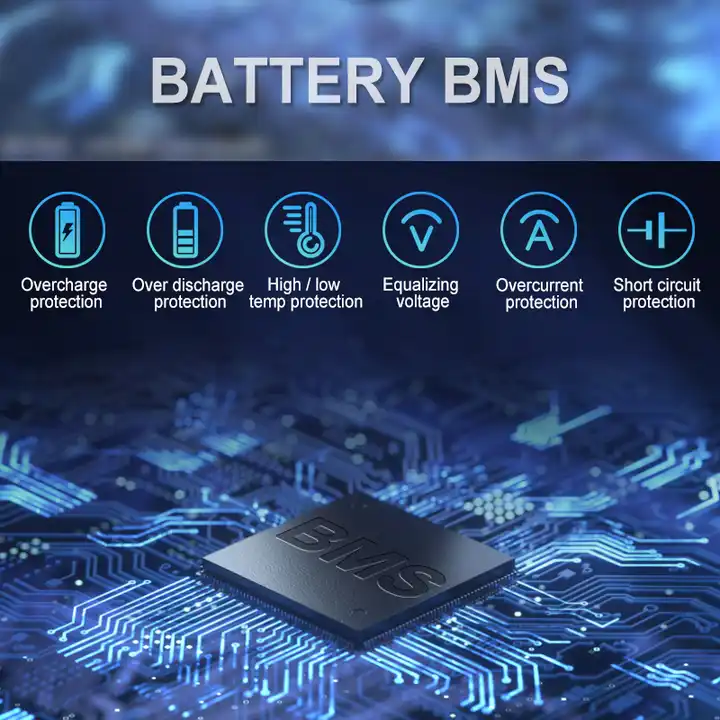
5.3.6 BMS
Unless otherwise specified by the user, the BMS shall have the following functions:
- a) Monitoring function: The BMS shall have the function of real-time monitoring of battery cell voltage, battery voltage, temperature, and current.
- b) Control and protection function: The BMS shall have the function of controlling battery charging and discharging, and shall have protection functions for over-discharge, over-charge, over-current, and over-temperature.
- c) Calculation function: The BMS shall have the function of calculating battery capacity (SOC – State of Charge) and cycle count. The SOC accuracy shall be no less than 10%.
- d) Communication function: The battery shall have the function of communicating with the host. The communication methods are mainly RS485 and CAN, and can upload battery charging and discharging status, protection status, alarm information, and other content.